How to swim breakstroke.
Mostrar mensagens com a etiqueta saúde. Mostrar todas as mensagens
Mostrar mensagens com a etiqueta saúde. Mostrar todas as mensagens
quinta-feira, março 07, 2013


quarta-feira, maio 23, 2012
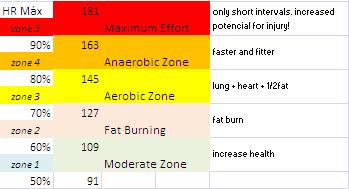
BPM training - by Sally Edwards in www.howtobefit.com
Base Branch
4-6 weeks
Aim for
three 30-minute workouts a week with about 10 minutes in Zone 1, Zone 2, Zone
3.
Your
ambient and your resting heart rate and blood pressure will drop and you'll see
your body change as you develop your ability to do continuous exercise time
Endurance
branch 4-6 weeks
Aim for
five 30-minute sessions a week. For each workout, spend 5 minutes in Zone 1, 10
minutes in Zone 2 and 15 minutes in Zone 3.
Your body
can now carry more oxygen to your muscles and break into your fat storage cells
to burn fat calories as it adapts to it's new workload. You'll find yourself
going the same distance at a lower heart rate
Strength
Branch - stay on this branch for maintenance of a healthy, all-around fit
lifestyle
Perform
four or five training sessions of 30-40 minutes each week divided as follows:
Zone 1, 5 minutes; Zone 2, 10 minutes; Zone 3, 20 minutes; Zone 4, 5 minutes.
The next
three branches are for those who seek to become high performance athletes…
Cross-train
while in each of these zones. This means varying the demands on your body by
walking one day, for example, biking the next, and swimming another
by ultra
athlete Sally Edwards
domingo, maio 13, 2012
BPM training - by bikeradar.com
Zone 6
(94-100% of MHR): For high-intensity interval training to increase maximum
power and speed
Zone 5 (89-94% of MHR): For raising anaerobic
threshold. Good sessions for 10- and 25-mile time-trials.
148 a 161 Zone
4 (82-89% of MHR): For simulating pace when tapering for a race.
136 a 148 Zone
3 (75-82% of MHR): For development of aerobic capacity and endurance with
moderate volume at very controlled intensity.
118 a 136 Zone
2 (65-75% of MHR): The basic base training zone. Longish rides of medium
stress.
109 a 118 Zone
1 (60-65% of maximum heart rate): For long, easy rides, to improve the
combustion and storage of fats.
Go Slower,
Get Faster: Key session: 3hrs in Zone 2.
Stay in the zone and stick to it. Don’t be tempted to push on the hills.
Burn Fat,
Save Time: Key session: 5min warm-up and
then 4-6 30sec sprints with 4-5min rest. (6-8 weeks)
Became an
endurance monster: Key session: 3-4hrs
in Zone 2 with 10min burst of Zone 3-4 every hour.
http://www.bikeradar.com/fitness/article/training-heart-rate-monitor-basics-28838/
quarta-feira, maio 09, 2012
BPM Training - by thewalkingsite.com
TRAINING ZONES
Healthy Heart Zone (Warm up) --- 50 - 60% of maximum heart rate: The easiest zone and probably the best zone for people just starting a fitness program. It can also be used as a warm up for more serious walkers. This zone has been shown to help decrease body fat, blood pressure and cholesterol. It also decreases the risk of degenerative diseases and has a low risk of injury. 85% of calories burned in this zone are fats!
Fitness Zone (Fat Burning) --- 60 - 70% of maximum heart rate: This zone provides the same benefits as the healthy heart zone, but is more intense and burns more total calories. The percent of fat calories is still 85%.
Aerobic Zone (Endurance Training) --- 70 - 80% of maximum heart rate: The aerobic zone will improve your cardiovascular and respiratory system AND increase the size and strength of your heart. This is the preferred zone if you are training for an endurance event. More calories are burned with 50% from fat.
Anaerobic Zone (Performance Training) --- 80 - 90% of maximum heart rate: Benefits of this zone include an improved VO2 maximum (the highest amount of oxygen one can consume during exercise) and thus an improved cardiorespiratory system, and a higher lactate tolerance ability which means your endurance will improve and you'll be able to fight fatigue better. This is a high intensity zone burning more calories, 15 % from fat.
Red Line (Maximum Effort) --- 90 - 100% of maximum heart rate: Although this zone burns the highest number of calories, it is very intense. Most people can only stay in this zone for short periods. You should only train in this zone if you are in very good shape and have been cleared by a physician to do so.
Fonte: http://www.thewalkingsite.com/thr.html
Healthy Heart Zone (Warm up) --- 50 - 60% of maximum heart rate: The easiest zone and probably the best zone for people just starting a fitness program. It can also be used as a warm up for more serious walkers. This zone has been shown to help decrease body fat, blood pressure and cholesterol. It also decreases the risk of degenerative diseases and has a low risk of injury. 85% of calories burned in this zone are fats!
Fitness Zone (Fat Burning) --- 60 - 70% of maximum heart rate: This zone provides the same benefits as the healthy heart zone, but is more intense and burns more total calories. The percent of fat calories is still 85%.
Aerobic Zone (Endurance Training) --- 70 - 80% of maximum heart rate: The aerobic zone will improve your cardiovascular and respiratory system AND increase the size and strength of your heart. This is the preferred zone if you are training for an endurance event. More calories are burned with 50% from fat.
Anaerobic Zone (Performance Training) --- 80 - 90% of maximum heart rate: Benefits of this zone include an improved VO2 maximum (the highest amount of oxygen one can consume during exercise) and thus an improved cardiorespiratory system, and a higher lactate tolerance ability which means your endurance will improve and you'll be able to fight fatigue better. This is a high intensity zone burning more calories, 15 % from fat.
Red Line (Maximum Effort) --- 90 - 100% of maximum heart rate: Although this zone burns the highest number of calories, it is very intense. Most people can only stay in this zone for short periods. You should only train in this zone if you are in very good shape and have been cleared by a physician to do so.
Fonte: http://www.thewalkingsite.com/thr.html
desporto e saúde
Após retomar o exercício em Junho do ano passado, essencialmente o btt, na altura com o objetivo de preparar o Caminho de Santiago desde o Porto, tenho feito muitos passeios mas sem grande rigor nos que diz respeito ao tipo de esforço que é feito: cardio, fat burn, endurance, etc...
Fiz alguma pesquisa e cheguei à conclusão que muitos kms que faço são para deitar fora em termos de melhoria da condição física ao mesmo tempo que são propensos a lesões. Esta pesquisa baseia-se essencialmente nas zonas de batimentos cardíacos em que os exercícios / treinos / passeios são feitos.
Decidi explorar este tema e iniciar um programa mais pensado de exercício com o objetivo de otimizar a condição física em termos de performance mas tb de saúde. Este é baseado nas dicas da ultra atleta Sally Edwards, veterana de inúmeros ironman.
Duas notas prévias aos próximos posts sobre este tema:
As zonas de batimentos cardíacos por minuto - bpm - são calculadas em percentagem do bpm máximo. Este apesar de ter variados métodos para o seu cálculo acaba por convergir em termos de output para o método mais simples de calcular: bpm máximo = 220 - idade.
Nenhum método resultará ... "IF YOU DON'T STOP EATING LIKE A PIG!!!". Esta será a primeira regra a ter em conta no programa.
Fiz alguma pesquisa e cheguei à conclusão que muitos kms que faço são para deitar fora em termos de melhoria da condição física ao mesmo tempo que são propensos a lesões. Esta pesquisa baseia-se essencialmente nas zonas de batimentos cardíacos em que os exercícios / treinos / passeios são feitos.
Decidi explorar este tema e iniciar um programa mais pensado de exercício com o objetivo de otimizar a condição física em termos de performance mas tb de saúde. Este é baseado nas dicas da ultra atleta Sally Edwards, veterana de inúmeros ironman.
Duas notas prévias aos próximos posts sobre este tema:
As zonas de batimentos cardíacos por minuto - bpm - são calculadas em percentagem do bpm máximo. Este apesar de ter variados métodos para o seu cálculo acaba por convergir em termos de output para o método mais simples de calcular: bpm máximo = 220 - idade.
Nenhum método resultará ... "IF YOU DON'T STOP EATING LIKE A PIG!!!". Esta será a primeira regra a ter em conta no programa.
Subscrever:
Mensagens (Atom)